
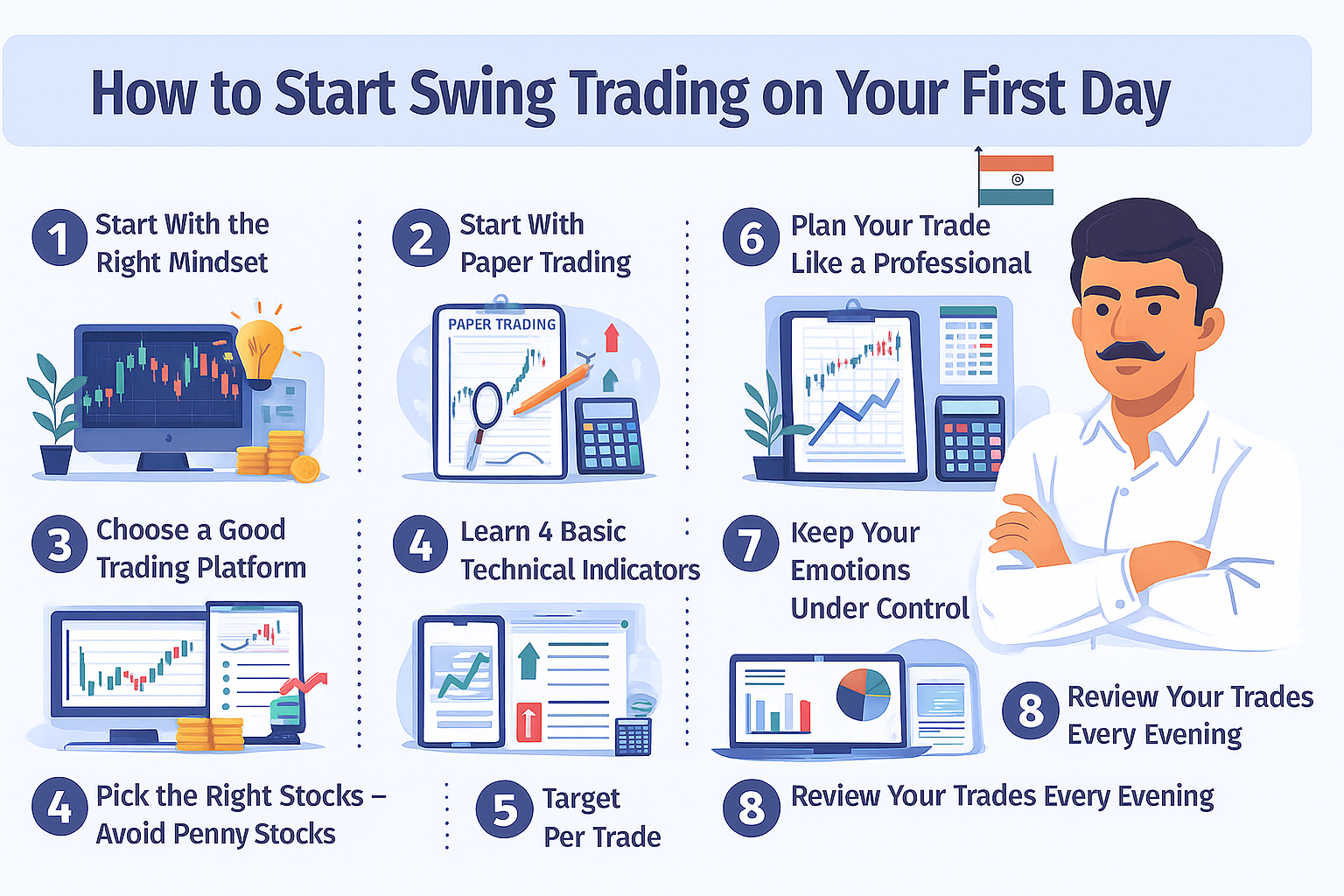
Starting swing trading for the first time can feel a bit confusing, but trust me, once you understand the basics, it becomes an exciting journey. In India, most of us grow up hearing about the stock market from elders, neighbours, or office colleagues. Everyone says, “Market mein risk hai,” but very few explain how to start properly. So today, let me share a practical, simple, Indian-style guide to begin swing trading on your very first day.
1. Start With the Right Mindset
Before entering the market, remind yourself that swing trading is not gambling. It is a disciplined approach where you buy stocks and hold them for a few days or weeks to capture the market swings. On day one, focus on learning, not earning. Profit will automatically follow once the process becomes strong.
2. Choose a Good Trading Platform
Your first step is to open a Demat + Trading account with a trusted broker like Zerodha, Upstox, or ICICI Direct. Make sure the platform has:
- Easy charts
- Technical indicators
- Smooth order execution
- Low brokerage
For swing trading, a good charting experience is more important than fancy features.
3. Learn 4 Basic Technical Indicators
You don’t need to learn 100 indicators. On the first day, just understand these four:
- Moving Averages (20 EMA, 50 EMA) – Helps you see the trend.
- RSI (Relative Strength Index) – Shows whether a stock is overbought or oversold.
- Volume – Confirms whether big players are active in the stock.
- Support & Resistance – Helps identify good entry and exit points.
These are enough to start swing trading confidently.
4. Pick the Right Stocks – Avoid Penny Stocks
As Indian beginners, we often get attracted to cheap penny stocks like “₹5 ka share 10 rupaye ho gaya toh double ho jayega!” But this thinking traps many new traders.
On your first day, choose stocks that are:
- From Nifty 50 or Nifty 200
- Highly liquid (good daily volume)
- Showing clear uptrend or downtrend
Avoid stocks that jump 20% in a day. Fast gainers often become fast losers.
5. Start With Paper Trading
Before risking real money, do paper trading for at least a few days. Just note down:
- Entry price
- Exit price
- Stop loss
This gives you confidence without burning your pocket.
6. Plan Your Trade Like a Professional
Even on the first day, learn to plan like serious traders:
- Entry point: At breakout or near support
- Stop loss: 2–3% below support
- Target: 5–10% profit
- Risk per trade: Never more than 2% of total capital
Remember, in swing trading, risk management is king.
7. Keep Your Emotions Under Control
In India, the biggest problem is “bhai ne bola, WhatsApp group ne bola, YouTube wala bol raha hai.” Avoid following tips blindly.
Use your own understanding. The market rewards discipline, not excitement.
8. Review Your Trades Every Evening
Swing trading improves only when you analyse your performance. Every evening, review:
- Why you entered the trade
- Why the stock moved in your favour or against you
- What you will do better tomorrow
This daily habit turns beginners into experts.
Conclusion
Starting swing trading on your first day is not about making big profits. It is about building the right foundation. With simple tools, proper planning, and a calm Indian mindset, you can slowly grow your portfolio and confidence.
Take it step by step. Learn daily. Trade with discipline.
And remember—in the share market, patience and knowledge always win
