
Swing trading can be exciting, especially when markets move quickly and opportunities appear almost every week. But every trader—new or experienced—knows that profits come only when risks are controlled. Without proper risk management, even the best strategy can collapse.
If you’re an Indian trader looking to reduce risk in swing trading, here are some practical, easy-to-follow tips.
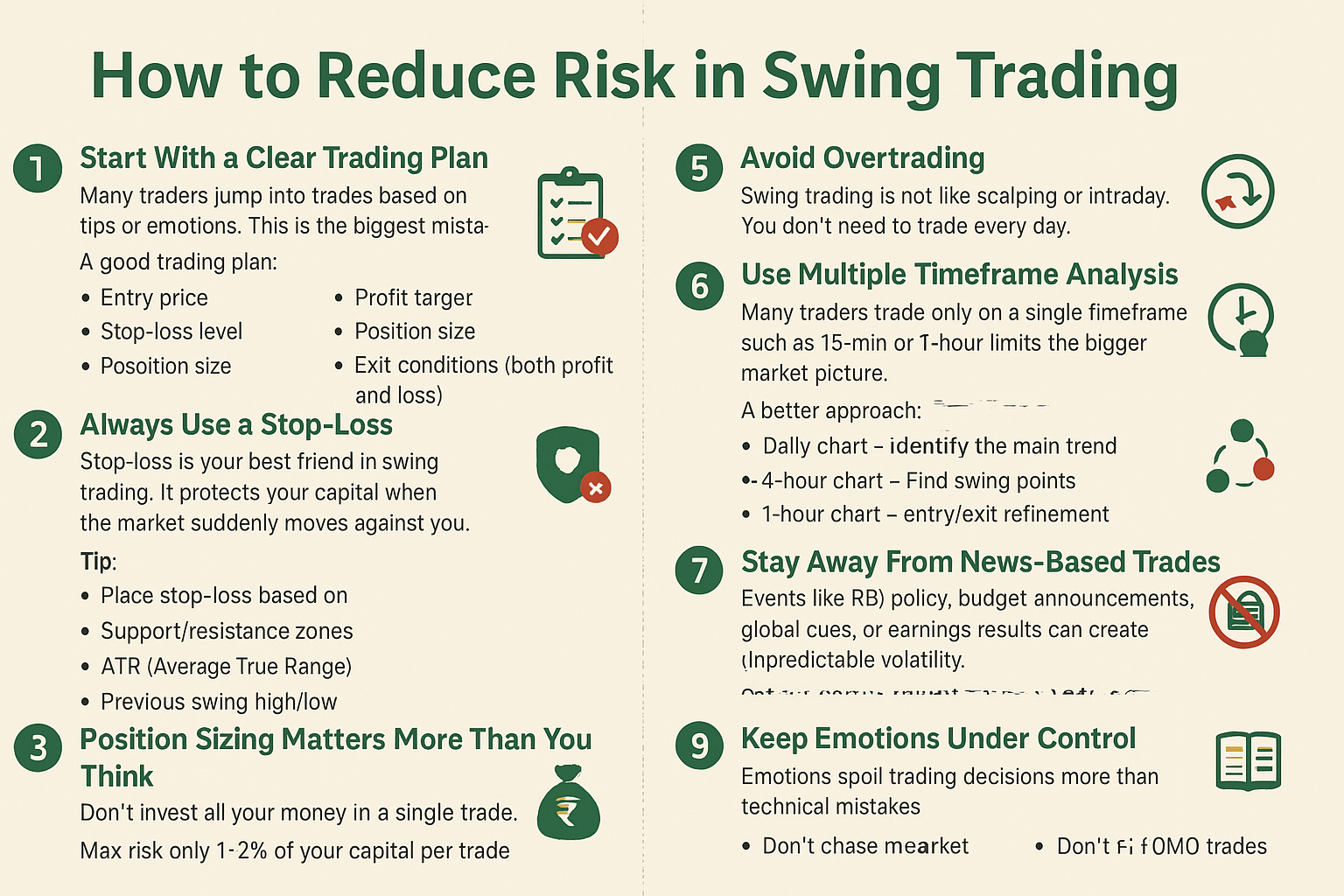
1. Start With a Clear Trading Plan
Many traders jump into trades based on tips or emotions. This is the biggest mistake.
A good trading plan includes:
- Entry price
- Stop-loss level
- Profit target
- Position size
- Exit conditions (both profit and loss)
Having a plan ensures you don’t make decisions based on fear or greed.
2. Always Use a Stop-Loss
Stop-loss is your best friend in swing trading.
It protects your capital when the market suddenly moves against you.
Tip:
Place stop-loss based on:
- Support/resistance zones
- ATR (Average True Range)
- Previous swing high/low
Never widen your stop-loss after entering a trade—it usually leads to bigger losses.
3. Position Sizing Matters More Than You Think
Don’t invest all your money in a single trade.
A common rule is risk only 1–2% of your capital per trade.
For example:
If your capital is ₹1,00,000
Max risk per trade = ₹1,000 to ₹2,000
This keeps you alive even after a series of losing trades.
4. Avoid Overtrading
Swing trading is not like scalping or intraday.
You don’t need to trade every day.
Choose only high-probability setups:
- Trend continuation
- Breakout retests
- Reversal patterns
Less trading = less risk + better accuracy.
5. Use Multiple Timeframe Analysis
Many Indian traders trade only on a single timeframe such as 15-min or 1-hour.
This limits the bigger market picture.
A better approach:
- Daily chart → Identify the main trend
- 4-hour chart → Find swing points
- 1-hour chart → Entry/exit refinement
This helps avoid trading against the main trend.
6. Diversify Your Trades
Don’t put all trades in the same sector.
Indian markets often move sector-wise (IT, Pharma, Bank Nifty, FMCG, etc.).
If all your trades are in banking stocks and Bank Nifty falls sharply, your whole portfolio suffers.
Spread your trades across different sectors for better risk control.
7. Stay Away From News-Based Trades
Events like RBI policy, budget announcements, global cues, or earnings results can create unpredictable volatility.
Swing traders should:
- Avoid taking fresh trades just before major news
- Tighten stop-loss if already in position
- Reduce position size during volatile weeks
8. Reward-to-Risk Ratio Should Be Favorable
Aim for a minimum 1:2 or 1:3 RR ratio.
This means you risk ₹1 to make ₹2 or ₹3.
Even if your accuracy is just 40–50%, you can still be profitable.
9. Keep Emotions Under Control
Emotions spoil trading decisions more than technical mistakes.
To manage emotions:
- Don’t chase the market
- Don’t increase position size after one winning trade
- Don’t trade to recover losses quickly
- Avoid FOMO trades
A calm mind is the biggest edge a swing trader can have.
10. Maintain a Trading Journal
Most Indian traders ignore this step, but journaling helps you grow faster.
Record:
- Date
- Entry/exit
- Reason for trade
- Profit/loss
- What went right/wrong
Reviewing your trades weekly helps you identify common mistakes and improve consistently.
Final Thoughts
Swing trading becomes safer and more profitable when you focus on risk management rather than just stock picking.
Remember:
Your goal is not to make quick money—your goal is to survive long enough to grow your capital steadily.
